





 English
 中文简体
中文简体 русский
 عربى
عربىHow is SMS non woven fabric manufactured?
Content
- 1 What SMS non woven fabric is and why the structure matters
- 2 Raw materials and line configuration used to make SMS
- 3 Step-by-step: how SMS non woven fabric is manufactured
- 4 Key process parameters that control GSM, strength, and barrier
- 5 Quality control checks used on SMS production lines
- 6 Troubleshooting: common manufacturing defects and how to fix them
- 7 Typical SMS specifications by application
What SMS non woven fabric is and why the structure matters
SMS non woven fabric is a three-layer composite made as Spunbond–Meltblown–Spunbond. The outer spunbond layers provide strength and abrasion resistance, while the meltblown middle layer provides fine-fiber barrier performance (filtration and fluid resistance). This “strength + barrier + strength” architecture is why SMS is widely used for medical gowns, drapes, masks, and industrial protective covers.
When people ask, “How is SMS non woven fabric manufactured?” the short answer is: polypropylene (PP) is melted and extruded into continuous filaments for spunbond layers, microfibers for meltblown, then the three webs are combined and thermally bonded into one roll with controlled basis weight, pore structure, and bonding pattern.
| Layer | Manufacturing method | Typical fiber diameter (practical range) | Primary contribution |
|---|---|---|---|
| Spunbond (S) | Continuous filament extrusion + drawing | ~15–35 μm (depends on die and draw) | Tensile strength, tear resistance, surface durability |
| Meltblown (M) | Microfiber extrusion attenuated by hot air | ~1–5 μm (fine fibers = higher barrier) | Filtration efficiency, fluid barrier, small pore size |
| Spunbond (S) | Same as first S layer | ~15–35 μm | Improves handling, abrasion resistance, and bonding stability |
Raw materials and line configuration used to make SMS
Polymer selection and melt quality
Most SMS is produced from polypropylene because it processes cleanly, forms stable filaments/microfibers, and offers a strong cost-to-performance ratio. In production, resin consistency matters: moisture control, filtration (screen packs), and stable melt flow reduce gels and shot that can create weak spots or pinholes in the barrier layer.
A practical view of the equipment layout
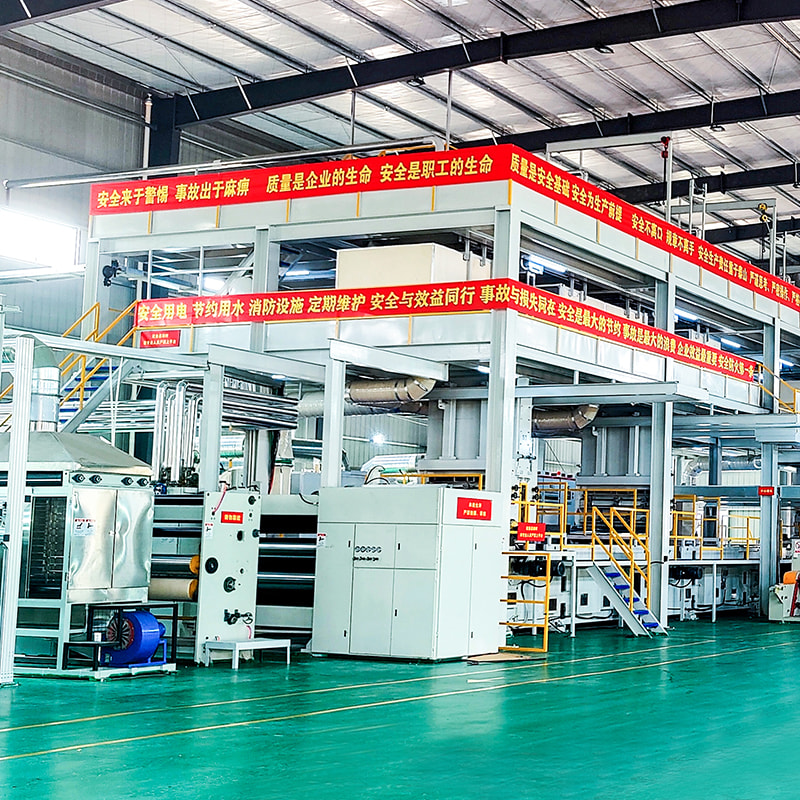
An SMS line typically integrates three web-forming stations (S + M + S) aligned over a moving forming belt, followed by bonding (often calendaring), finishing (slitting, winding), and in-line inspection. The critical design principle is keeping each web stable until it is consolidated; the meltblown layer is especially sensitive to airflow, electrostatics, and draft.
- Extruders (often separate for spunbond and meltblown) with melt pumps for stable throughput
- Spinnerets/dies: spunbond filament die and meltblown die with hot-air attenuation system
- Drawing/air handling: quench air for spunbond, high-velocity hot air for meltblown
- Web laydown and electrostatic control (to reduce web flutter and defects)
- Thermal bonding (calendar rolls) and optional surface treatments (e.g., hydrophilic finish)
Step-by-step: how SMS non woven fabric is manufactured
Below is the practical production sequence used on most integrated SMS lines. The exact temperatures and line speeds vary by resin grade, target GSM, bonding pattern, and end-use requirements (medical vs. industrial).
- PP resin is dried/conditioned (as needed) and fed into the extruder(s) to create a stable polymer melt.
- First spunbond (S1): the melt is extruded through a filament die, quenched, and drawn to form continuous filaments. These filaments are laid onto a moving belt as a uniform web.
- Meltblown (M): polymer is extruded through a meltblown die and attenuated by high-velocity hot air to create microfibers. The microfiber stream is collected as a fine, high-surface-area web directly onto (or between) the spunbond layers.
- Second spunbond (S2): a second spunbond web is formed on top of the meltblown layer to complete the sandwich structure.
- Thermal bonding: the three-layer composite passes through heated calendar rolls. Bond points fuse layers without fully collapsing the pore network. The bonding pattern and nip pressure are tuned to balance strength and barrier.
- Finishing: optional topical treatments (e.g., hydrophilic surfactant for absorbency, antistatic finish) are applied depending on end use.
- Winding and converting: the fabric is trimmed, slit to width, wound into rolls, and labeled with lot traceability. In-line inspection flags holes, thin spots, and contamination.
Manufacturing insight: the meltblown layer usually drives barrier performance, but the spunbond layers heavily influence runnability and mechanical durability. Optimizing SMS is therefore a balancing act, not “maximize meltblown at all costs.”
Key process parameters that control GSM, strength, and barrier
Basis weight (GSM) targets and layer splits
SMS is commonly produced across a wide range of basis weights depending on application. As a practical reference point, many medical and hygiene SMS products fall in the ~15–60 GSM range, with heavier grades used when puncture/tear resistance is critical. A frequent engineering lever is the S/M/S split (how much GSM is allocated to each layer) to tune breathability versus barrier.
Meltblown attenuation and pore structure
Barrier performance is strongly tied to meltblown fiber diameter and web uniformity. Finer fibers (often ~1–5 μm) increase surface area and reduce pore size, improving filtration and fluid resistance. However, overly aggressive attenuation or unstable air handling can cause “ropey” fibers, thin spots, or inconsistent basis weight, which is a common cause of barrier failures.
Thermal bonding window (strength vs. breathability)
Calendar temperature, nip pressure, and bonding pattern determine how much the fibers fuse at bond points. Too little bonding reduces tensile/tear strength and can lead to delamination. Too much bonding can collapse pores and reduce softness and breathability. Practical optimization usually targets a stable bond integrity while protecting the meltblown layer from excessive crush.
| Property you want to improve | Primary lever | Typical trade-off to manage |
|---|---|---|
| Filtration / fluid barrier | Finer meltblown fibers; higher M-layer uniformity | Breathability can decrease if pores become too tight |
| Tensile / tear strength | Higher spunbond contribution; optimized bond pattern | Hand feel may become stiffer at higher bonding intensity |
| Softness / drape | Bond pattern selection; spunbond filament sizing | Lower bonding may reduce durability and abrasion resistance |
| Uniform appearance (low defects) | Stable melt flow, air balance, and electrostatic control | May require tighter maintenance and filtration discipline |
Quality control checks used on SMS production lines
SMS is frequently manufactured for regulated or high-reliability uses, so quality control typically combines in-line monitoring (weight uniformity, holes) with lab testing (strength, barrier). The goal is to confirm that the meltblown layer is continuous and that bonding is strong enough to prevent delamination during converting and end use.
Common in-line and lab measurements
- Basis weight mapping (GSM profile across width) to detect thin bands or streaks
- Tensile and tear performance to validate spunbond integrity and bonding adequacy
- Barrier checks such as hydrostatic head or synthetic blood penetration (application-dependent)
- Filtration metrics (e.g., BFE/PFE) when producing medical-mask or filter-grade SMS
- Visual defect inspection: pinholes, gels, foreign material, delamination, and uneven bonding
Practical acceptance logic: If a roll passes mechanical targets but fails barrier targets, the root cause is often meltblown uniformity (air balance, die condition, throughput stability). If barrier is good but strength is weak, bonding window or spunbond contribution is frequently the bottleneck.
Troubleshooting: common manufacturing defects and how to fix them
Because SMS relies on a delicate meltblown middle layer, many production issues show up as barrier failures, streaking, or inconsistent appearance. The most efficient troubleshooting approach is to isolate whether the issue originates in melt flow, air handling, web laydown, or bonding.
Typical symptoms and corrective actions
- Pinhole or low-barrier zones: check meltblown die cleanliness, screen pack condition, and air balance; verify M-layer basis weight stability.
- Web flutter / uneven laydown: review drafts around the forming area, electrostatic control, and collector vacuum settings.
- Delamination between layers: confirm bonding temperature/nip pressure; ensure the composite enters the calendar with stable web tension and no contamination.
- Harsh hand feel or crushed structure: reduce bonding severity (temperature/pressure) or adjust bond pattern; verify calender roll condition.
- Streaks or bands across width: look for die lip damage, uneven air distribution, or inconsistent polymer throughput.
Typical SMS specifications by application
SMS is not a single “one-size-fits-all” fabric. Manufacturers typically select basis weight, layer split, and bonding pattern based on the end-use performance envelope. The examples below illustrate how practical requirements map to manufacturing choices.
| Application | Typical GSM band (practical) | What is prioritized | Manufacturing emphasis |
|---|---|---|---|
| Medical gowns & drapes | ~25–60 | Fluid barrier + tear resistance | Uniform meltblown; robust bonding without pore collapse |
| Mask inner layers / filter media | ~15–40 | Filtration efficiency + breathability | Fine meltblown fibers; tight GSM control; defect minimization |
| Hygiene backsheet/industrial covers | ~12–35 | Cost efficiency + basic barrier | Higher spunbond share; stable high-speed operation |
| Protective packaging / cleanroom wraps | ~30–80 | Strength + low linting | Bond pattern and spunbond integrity; contamination control |
Bottom line: SMS manufacturing is successful when the meltblown layer is uniform and protected, and the spunbond layers are bonded enough to deliver durable handling without sacrificing the designed pore structure.







 +8613621544385
 No.29 Xinhua Road, Jiashan Village,Jiaxing City Zhejiang P.R., China