

 English
 中文简体
中文简体 русский
 عربى
عربىWhat Is Landscape Fabric Made Of? Materials, Types, and Specs
What landscape fabric is made of (core polymers)
If you’re asking what landscape fabric is made of, the short answer is: most products are synthetic geotextiles made from polypropylene (PP) or polyester (PET). These polymers are chosen because they resist rot, tolerate moisture, and maintain tensile strength in soil-contact environments.
Typical material constructions you’ll see on rolls and spec labels include:
- Polypropylene (PP): Common in both woven and nonwoven fabrics; generally lighter, hydrophobic, and cost-effective for weed suppression.
- Polyester (PET): Often used for nonwoven “felt-like” fabrics; tends to have good dimensional stability and can perform well in drainage and filtration roles.
- Polyethylene (PE) films or composites: Used in some “weed barrier” products that behave more like a film with perforations; these are less breathable and can trap water if poorly designed.
Woven vs nonwoven vs perforated barrier: how the fabric is formed
The “made of” question isn’t only the polymer—it’s also the structure. Structure determines water flow, tear behavior, and long-term performance under mulch, soil, or gravel.
Woven landscape fabric
Woven products are made by interlacing flat tapes or fibers (often PP) in a grid. They usually have higher tensile strength for their weight, making them common under rock paths or gravel. The tradeoff is that pore openings can clog with fines, especially in silty soils, reducing water infiltration over time.
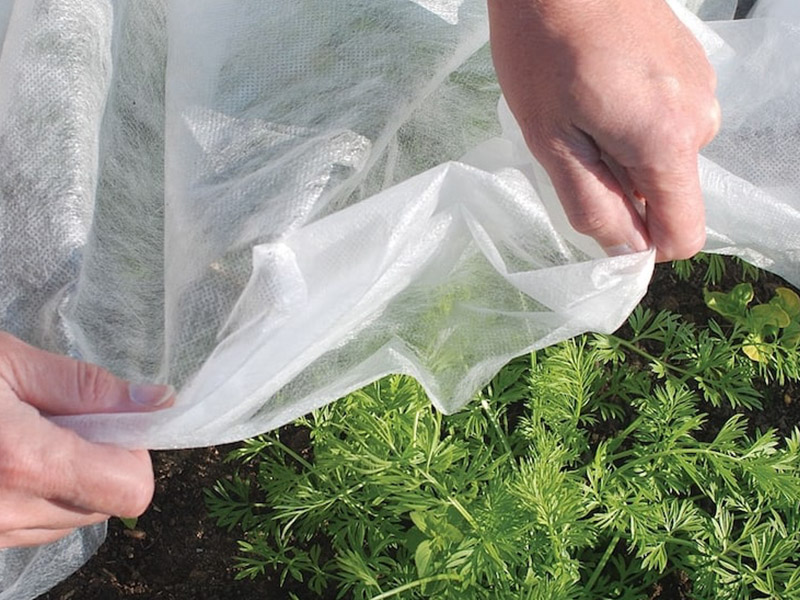
Nonwoven landscape fabric
Nonwoven products are made by bonding fibers into a sheet—often “spunbond” or needle-punched constructions. They feel more like a dense felt and typically offer more uniform filtration, making them popular where drainage matters (e.g., behind retaining walls or around French drains). Nonwoven fabrics can be more puncture-resistant in some builds because fibers distribute loads differently than a woven grid.
Perforated film barriers
Some low-cost “weed barriers” are perforated plastic films (commonly PE). They can block weeds initially, but their water/air exchange is often limited and they can create pooling or anaerobic soil pockets. Use these cautiously in planting beds, especially where you care about soil health and root respiration.
Additives and surface treatments that change durability
Two landscape fabrics made from the same polymer can perform very differently depending on stabilizers and finishing processes.
- UV stabilizers: Critical if the fabric will see sunlight (even intermittently). Without stabilization, many plastics become brittle faster when exposed.
- Thermal bonding / calendaring: Heat/pressure can smooth the surface, reduce fuzzing, and alter pore structure—often improving weed resistance but sometimes reducing permeability.
- Hydrophilic finishes: Some nonwovens are treated to wet out more readily, improving consistent water passage rather than beading.
- Colorants (typically black): Dark fabrics block light, which supports weed suppression, but color alone is not a guarantee of thickness or strength.
Practical takeaway: if a label claims “UV resistant,” look for wording that suggests stabilization is part of the material, not just a marketing claim. When it matters, ask for a data sheet.
Specs that tell you how the material will behave (with realistic ranges)
Landscape fabric performance is easier to predict if you translate the roll into a few measurable specs. Manufacturers vary, but these ranges are common starting points for comparison.
| Spec | Typical range (consumer to pro-grade) | Why it matters |
|---|---|---|
| Weight | ~50–200 gsm (about 1.5–6 oz/yd²) | Heavier usually means better puncture resistance and longer life under rock/mulch. |
| Permeability / flow | Varies widely by structure | Affects drainage; too low can cause pooling, too open can allow fines to clog. |
| Puncture resistance | Higher in thicker nonwovens and some reinforced wovens | Critical under gravel where angular stone loads can tear thinner sheets. |
| UV stability | Depends on stabilizer package | Important for exposed edges and installations delayed before covering. |
A practical rule: if your fabric will sit under decorative rock or a high-traffic path, prioritize puncture resistance and weight over marketing terms like “heavy duty.”
Material-to-application matching (examples that prevent common failures)
Mulched planting beds
For beds with shrubs or ornamentals, a breathable nonwoven (often PP or PET) tends to be more forgiving. It allows water to pass and helps reduce puddling under mulch. However, expect windblown organic matter to form a “soil skin” on top over time; weeds can germinate in that layer even if the fabric blocks the soil below.
Under gravel paths, decomposed granite, or pavers
Woven PP (or a reinforced nonwoven) is often selected for strength. Use a thicker grade if the aggregate is angular. A common failure mode is thin fabric tearing during compaction; once torn, stone migrates into subgrade and ruts appear.
Drainage features (French drains, retaining walls)
Nonwoven filtration fabrics are frequently used to separate soil from drain rock, helping reduce clogging of the aggregate. In these cases, filtration behavior (pore structure) can matter more than weed suppression.
Buying checklist: how to judge the “made of” claim on the label
When you are comparing rolls, use a quick, repeatable review process so you don’t overpay for vague claims.
- Confirm the polymer: look for PP or PET wording rather than just “fabric” or “weed barrier.”
- Check structure: woven vs nonwoven; match to your application (strength vs filtration).
- Look for weight (gsm or oz/yd²): if missing, treat the product as an unknown grade.
- Ask about UV stabilization if any part will be exposed or if installation will be staged.
- Evaluate puncture risk: angular rock and compaction call for heavier, tougher fabrics.
Conclusion: “Landscape fabric” is usually PP or PET, but the structure and specs determine whether it performs like a durable separator or a short-lived weed sheet.


 +8613621544385
 No.29 Xinhua Road, Jiashan Village,Jiaxing City Zhejiang P.R., China